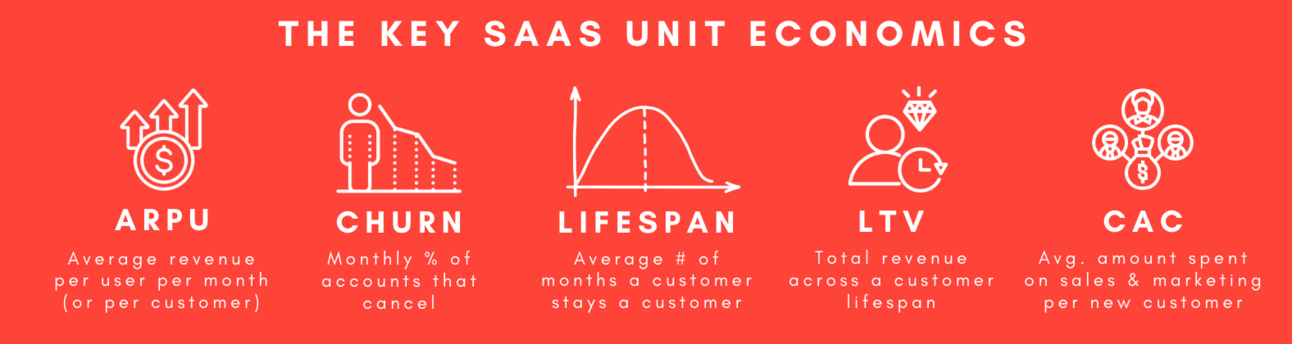
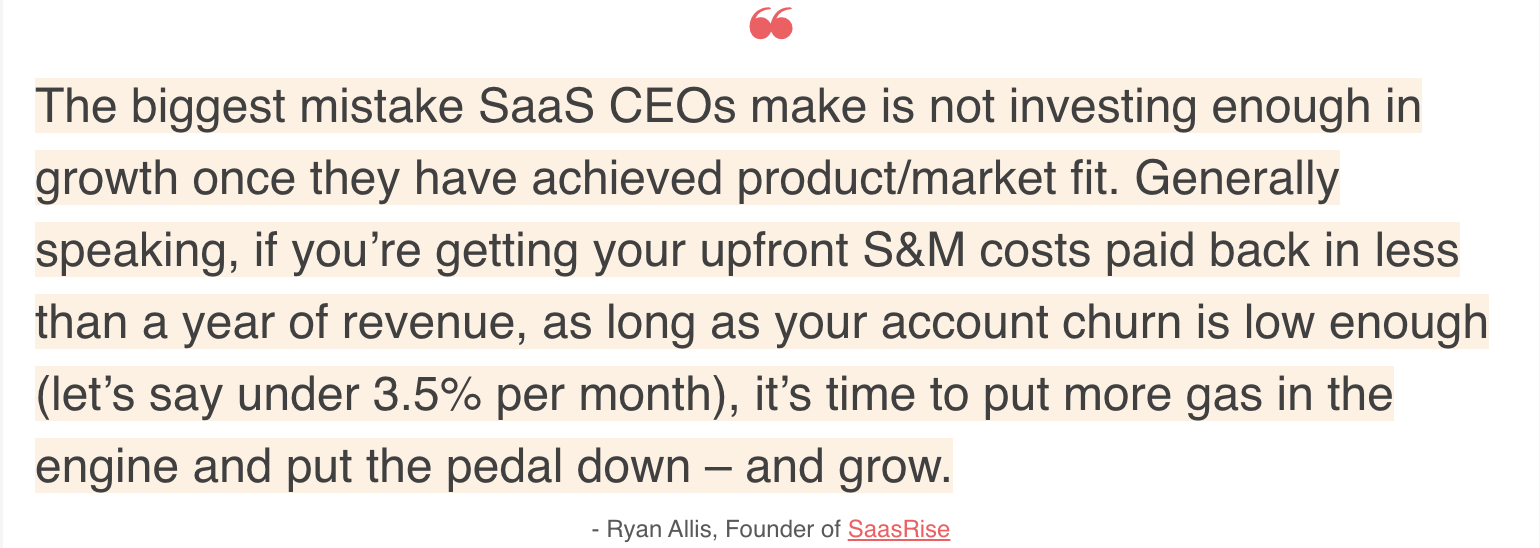
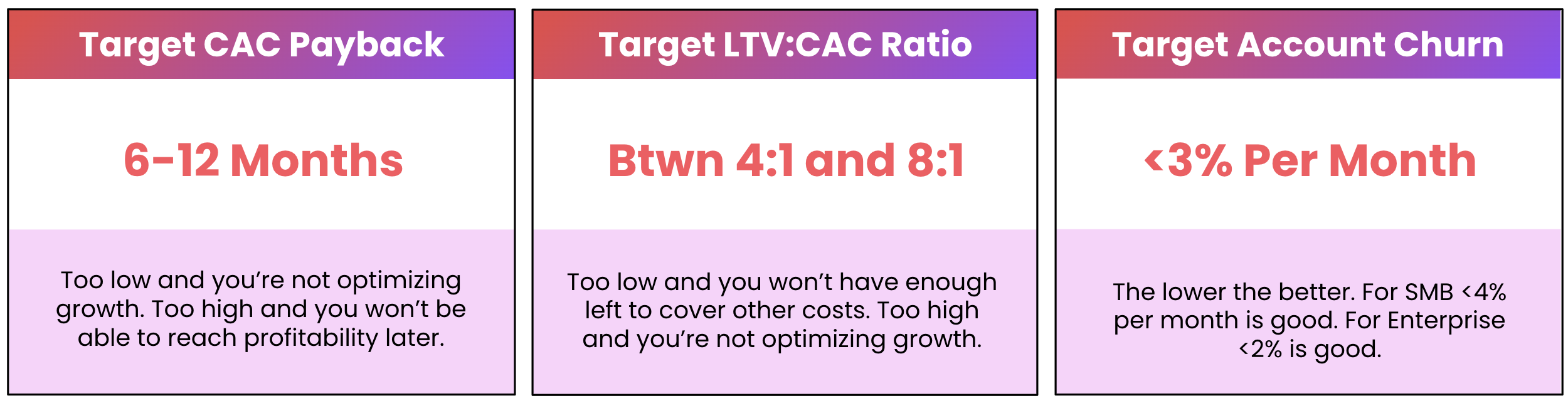
At a high level, if your company’s account churn is under 3.5% per month and your CAC is less than 1/6th of your LTV, it’s time to scale up your sales and marketing efforts — and grow faster.
If your account churn is over roughly 3.5% per month, you’re in a yellow zone and it’s important to slow down and focus on product improvement, account management, integrations, and stickiness before you scale up your paid sales and marketing engines any further.
You should always work on reducing churn — it’s an ongoing process. But once you get your customer life to be above 30 months (which happens at 3.5% monthly churn), it’s critical to begin rapidly scaling up the top of your funnel while you make continual improvements to the bottom of the leaky bucket of account churn.
In addition to looking at payment months, look at LTV:CAC ratio. If your expected average lifetime revenue (LTV) from an incremental new customer is more than 6 times your upfront cost of customer acquisition, scale up that system all day long.
LTV:CAC ratios depend on whether you're venture-backed or trying to be profitable. Here's a good rubic for LTV:CAC ratios:
- 8:1 Ratio = Optimizing for profitability
- 6:1 Ratio = Optimizing for a balance of profitability and growth
- 4:1 Ratio = Optimizing for growth (usually VC-backed)
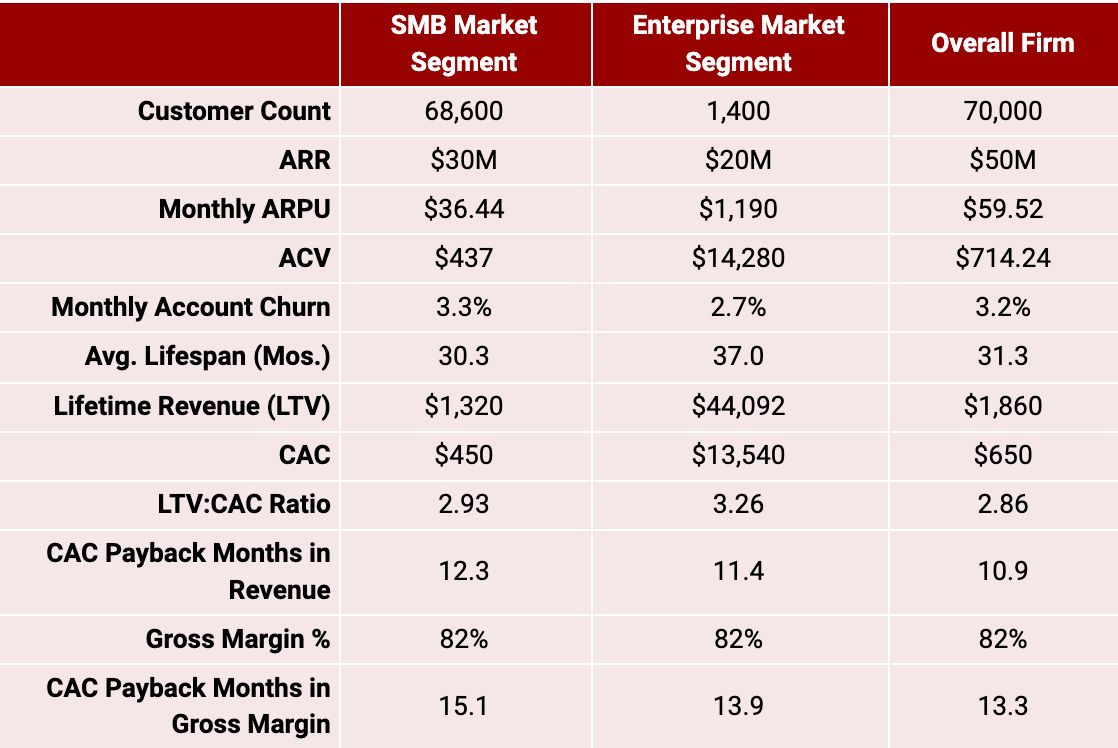
The Actual Unit Economics for Our Two Market Segments: SMB and Enterprise
At iContact, we built two different product offerings targeted at different market segments: iContact and iContact Enterprise. Each of these products had their own unique unit economics.
iContact was targeted at small businesses who paid on average $36/mo (range of $10/mo to $1000/mo) and iContact Enterprise was targeted at mid-sized businesses and larger senders who paid an average of $1190 per month (range of $800/mo to $50k/mo). It was essentially the same product with a couple added features and access to a shared account manager.
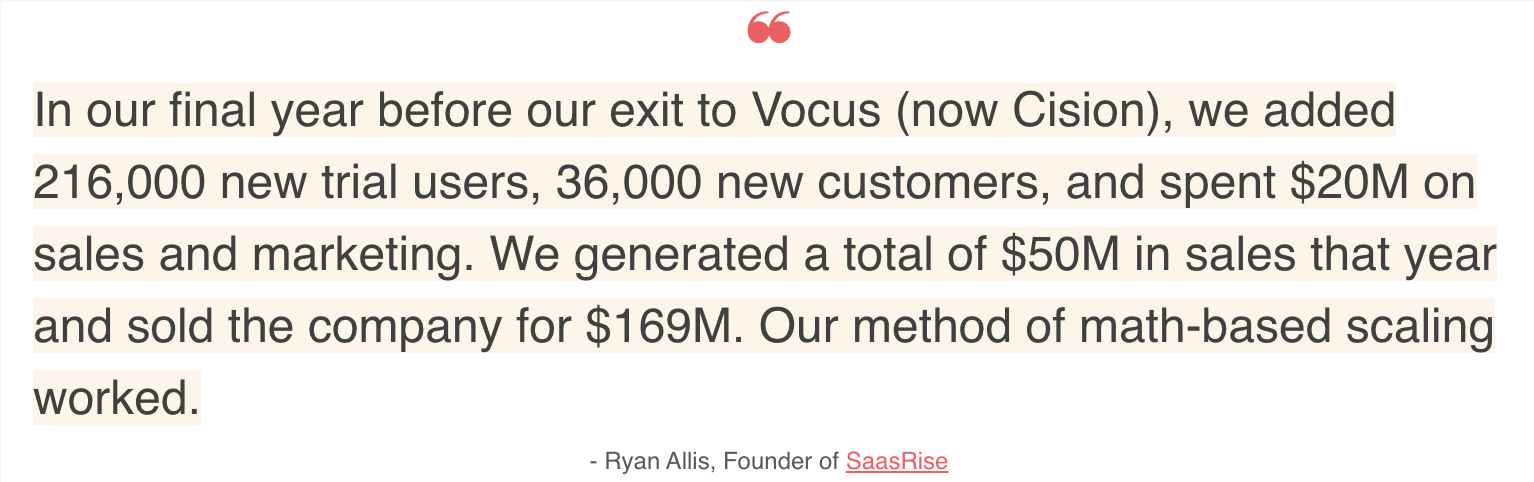
We marketed iContact via Google search ads, resellers, affiliates, online review sites, SEO, postcards, and radio ads. We offered a 15 day free trial and converted about 16% of our free trials into paying customers via an automated email follow-up sequence.
At the peak we were adding 18,000 new free trials per month. Later on, we switched to a freemium model (free for small accounts under 1000 subscribers), which initially performed worse, but after the network effect took place it ended up performing better for us than a free trial.
iContact Enterprise was marketed via similar channels – with the only difference being that prospects had to already have 50,000 subscribers on their email list (we asked at the time of trial signup) before we’d invest the time/money to approach them with the Enterprise offering. If the prospect indicated they had that scale already, we’d have a sales development rep (SDR) call them to set up a demo. We also had SDRs reach out to prospects via outbound email campaigns.
Once our SDRs had validated that the client had the list size and the budget, they’d pass the opportunity to a Sales Executive to close the deal. Once the account was closed, they’d be passed over to an Account Manager to manage and grow the client revenue. Land and expand.
Because we knew our unit economics cold, we were able to get solid investment term sheets from Bessemer, Updata, JMI Equity — and our eventual buyer.