|

|
Ryan Allis
|
|
The AI Software Valuation Report 2026
This report compares venture capital investment multiples and M&A revenue multiples across three categories of software companies in Q1 2026: AI-Native Software, AI-Enabled Software, and Legacy SaaS. Using data from Finro, Windsor Drake, Aventis Advisors, PitchBook, Software Equity Group, and other industry sources covering 575+ AI companies and 620+ M&A transactions, we quantify the growing valuation gap between these three tiers.
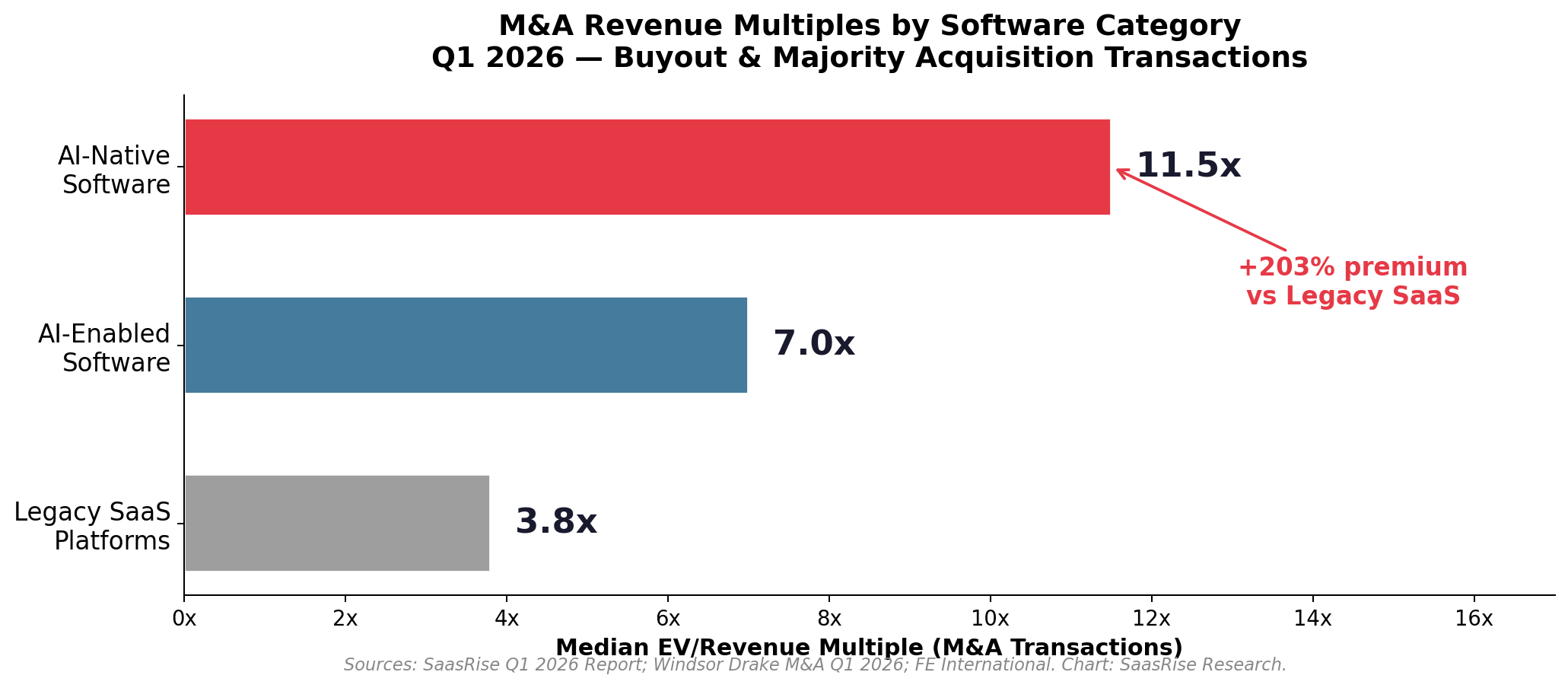
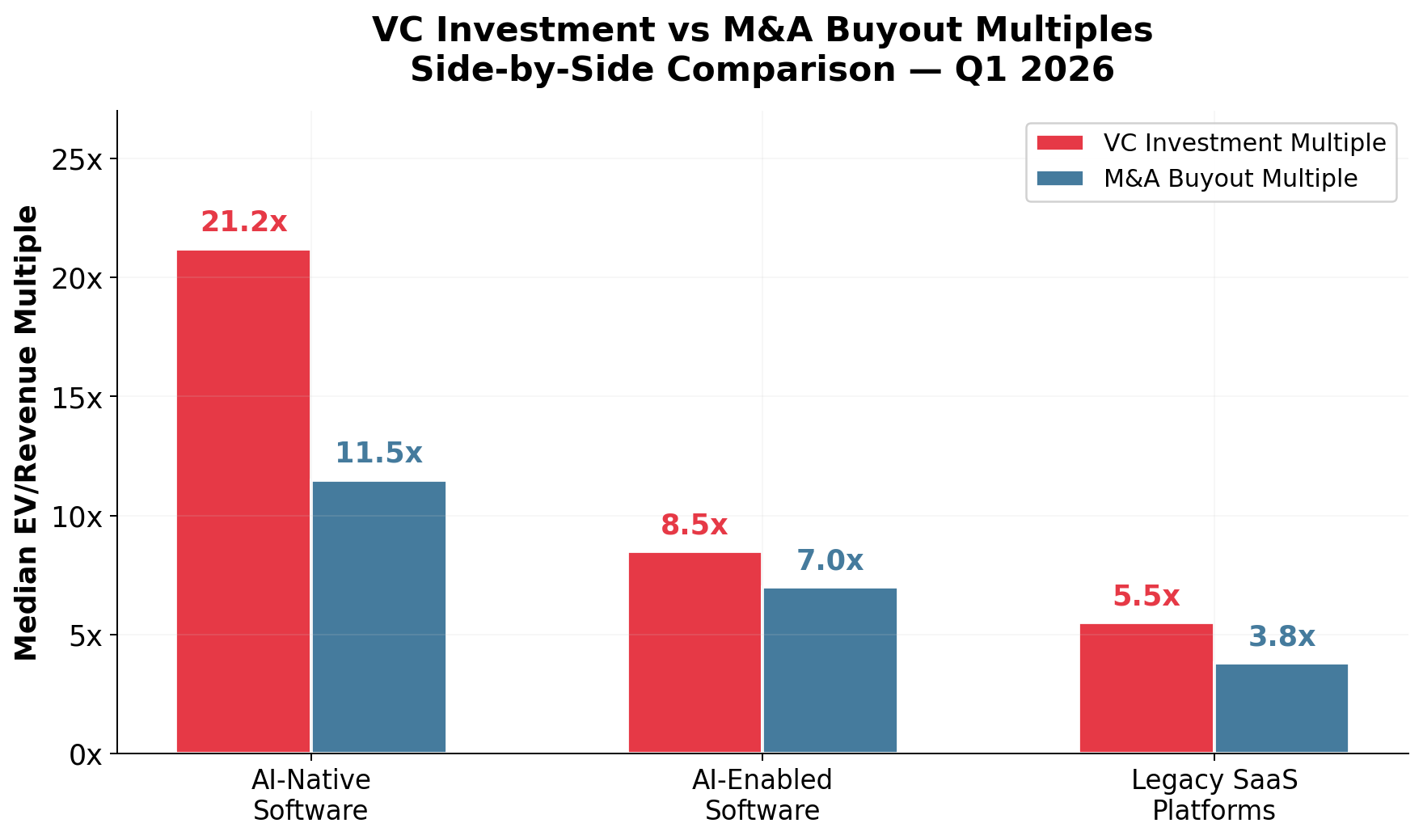
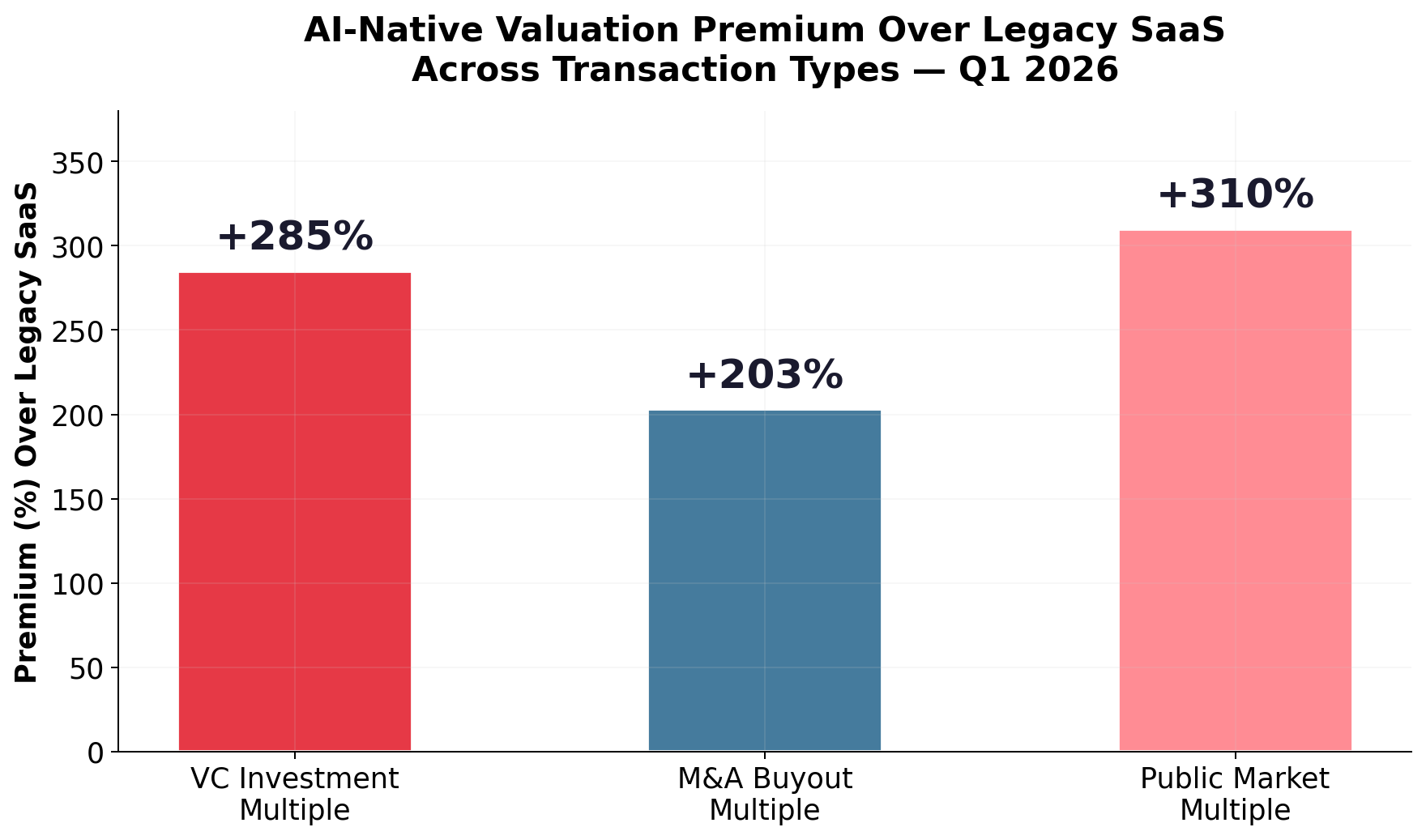
The findings are striking. AI-native companies command a median 21.2x EV/Revenue in VC rounds and 11.5x in M&A buyouts, compared to just 5.5x (VC) and 3.8x (M&A) for legacy SaaS — a premium of 200–285%.
Published by SaasRise, the #1 mastermind community for SaaS CEOs with $1M–$100M+ in ARR. Members have collectively raised $1B+ and have $3B+ in ARR.
|
|
VC Deal Multiples (Minority Investment Rounds)
|
|
M&A Deal Multiples (Buyout Transactions)
|
|
Why are M&A multiples lower than VC multiples? VC investments are typically made earlier when growth rates are highest and revenue bases are smaller, so investors pay a premium for future potential. M&A buyouts occur later — when companies have larger revenue bases, slower growth, and acquirers are pricing current cash flows. The result: M&A multiples are structurally lower, but represent realized exit values rather than paper valuations.
|
|
|
|
This report examines the growing valuation divergence across three categories of software companies. Using Q1 2026 and April 2026 data from Finro, Windsor Drake, Aventis Advisors, PitchBook, Software Equity Group, and other industry sources, we quantify the AI valuation premium across both venture capital investment rounds and M&A transactions.
The data supports a clear hypothesis: companies that are AI-native consistently receive higher revenue multiples in both VC investment rounds and M&A buyout transactions, and this premium is accelerating in 2026.
|
1. Defining the Three Categories
Not all software companies are valued equally. As AI reshapes the technology landscape, investors and acquirers are increasingly segmenting the software market into three distinct tiers, each commanding fundamentally different valuation multiples.
|
1. AI-Native Software Companies
Core product and competitive moat built entirely around AI from inception
Definition: Companies whose core product is built entirely around artificial intelligence. AI is not a feature — it is the product.
Examples: OpenAI ($300B, 81.1x EV/Revenue), Anthropic ($61.5B, 70.3x), Cursor ($50B), Harvey ($11B), ElevenLabs ($11B), Perplexity ($20B), Synthesia ($4B).
Key Characteristics: Proprietary AI models or unique data moats; consumption-based pricing; AI agents replacing human workflows; NRR often exceeding 135%; exponential revenue growth.
|
|
2. AI-Enabled Software Companies
Established software with meaningful AI integration creating measurable customer value
Definition: Established software companies that have meaningfully integrated AI capabilities into existing products.
Examples: Palantir (20.3x), CrowdStrike, Datadog, ServiceNow, Palo Alto Networks, Salesforce (Agentforce, $800M ARR), Snowflake, Databricks ($5.4B ARR, 140% NRR).
Key Characteristics: Meaningful AI integration; AI drives measurable customer ROI; hybrid pricing; strong retention; typically 15-40% revenue growth.
|
|
3. Legacy SaaS Platforms (No Meaningful AI)
Traditional per-seat SaaS without meaningful AI — highest disruption risk
Definition: Traditional SaaS companies relying primarily on per-seat subscription models without meaningful AI integration.
Examples: Many horizontal point-solution SaaS in CRM, project management, HR, document management; products where one AI agent can replace 5+ seats.
Key Characteristics: Per-seat subscription pricing; revenue growth below 10-12%; limited AI integration; high vulnerability to AI substitution; shrinking TAM.
|
|
2. VC Investment Revenue Multiples
VC investment multiples measure enterprise value (EV) divided by revenue at the time of a minority venture investment round. These are not buyout prices — they reflect what investors pay for a minority stake at Series A through Series D+.
The AI-Native Premium in VC Rounds
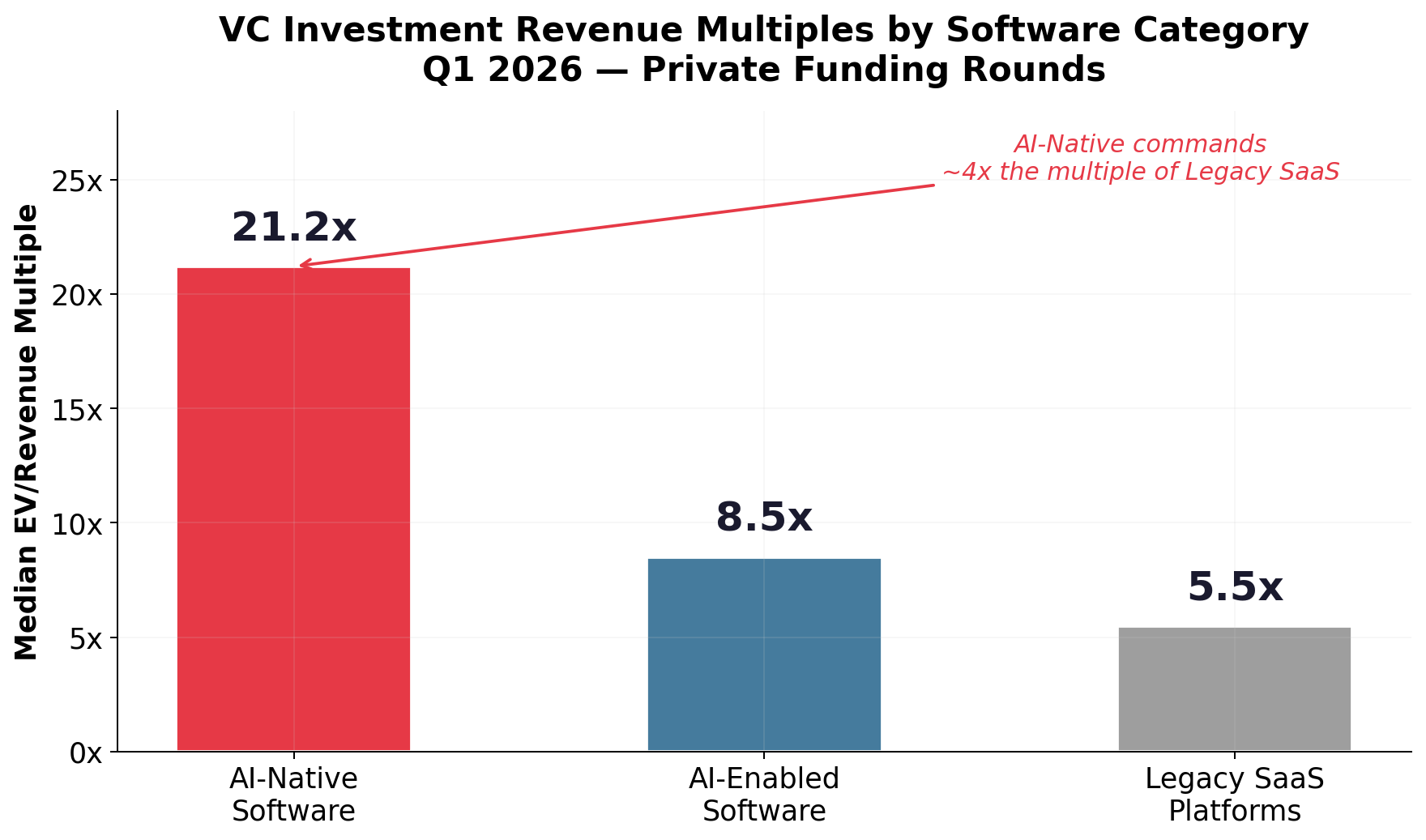
According to Finro’s Q1 2026 dataset covering 575 AI companies, the median VC investment multiple for AI infrastructure was 21.2x EV/Revenue, with 39.5x for LLM vendors and 36.9x for AI search engines.
Windsor Drake’s Q1 2026 Report shows private SaaS venture multiples ranging from 4.8x to 5.3x. AI-native platforms command 16x to 18x — a 40-80% premium.
Aventis Advisors found a median of 29.7x across AI fundraising rounds vs. ~6x for public SaaS. Eqvista confirmed AI companies average 37.5x vs. just 7.6x for SaaS.
|
|
|
Key Insight — VC Multiples: AI-native companies command a median 21.2x EV/Revenue, roughly 4x the 5.5x median for legacy SaaS. The range is enormous — from 10x for applied AI to 75x+ for LLM vendors.
|
|
VC Multiples by AI Niche
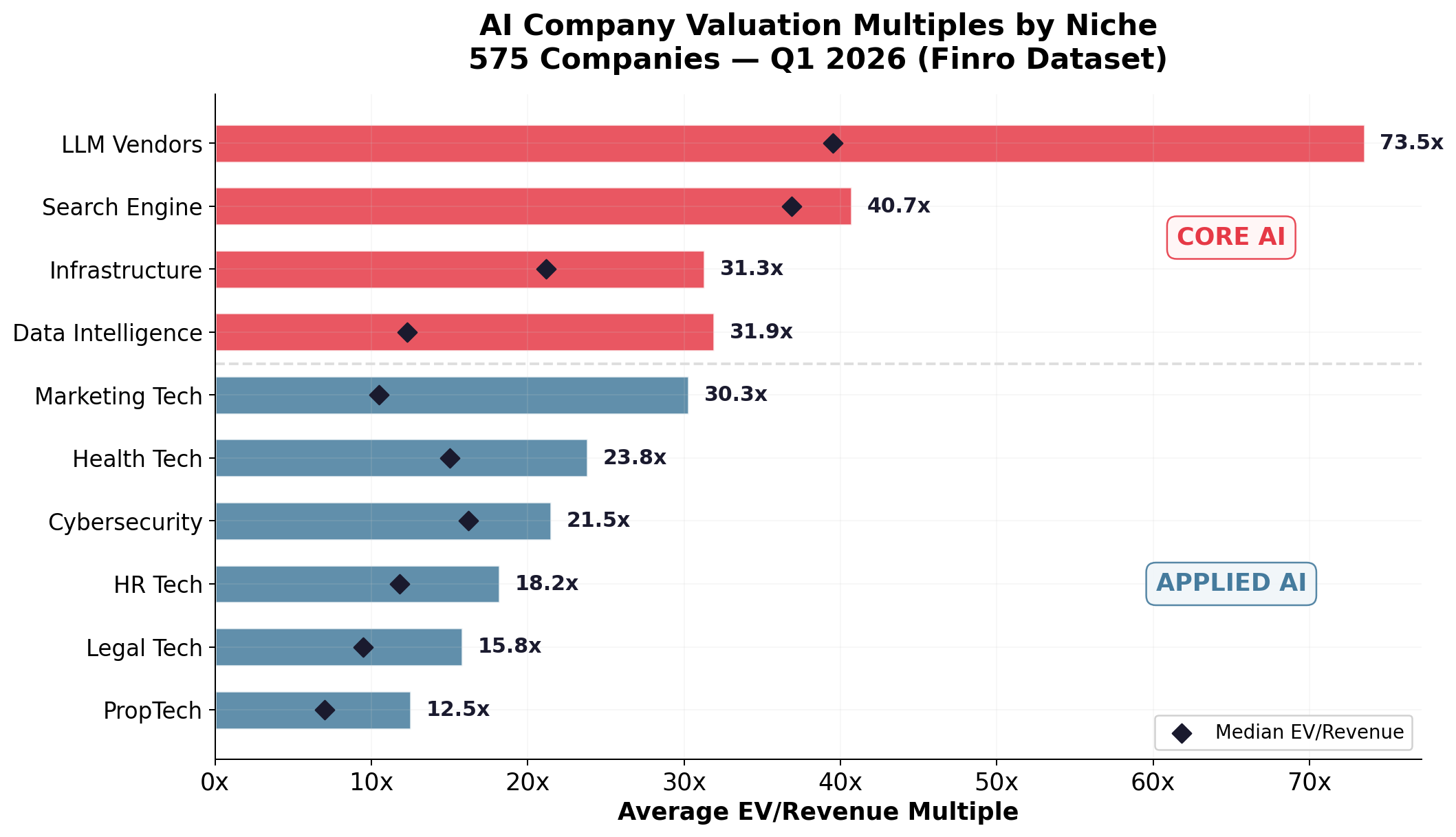
Finro’s dataset reveals dramatic dispersion across 15 AI niches. The highest multiples accrue to foundational “picks and shovels” — LLM Vendors (73.5x average), AI search engines (40.7x), and infrastructure providers (31.3x). Applied AI in specific verticals trades at lower but substantial premiums: Health Tech (23.8x), Marketing Tech (30.3x), and Cybersecurity (21.5x).
|
|
|
The Finro Q1 2026 Update highlights: Core AI and Applied AI did not converge — the gap widened. Investors increasingly price commercialization certainty rather than technical sophistication.
|
Landmark VC Rounds: The Numbers Behind the Headlines
| Company |
Category |
Valuation |
EV/Rev |
| OpenAI | AI-Native (LLM) | $300B | 81.1x |
| Anthropic | AI-Native (LLM) | $61.5B | 70.3x |
| Cursor | AI-Native (Dev) | $50B | ~25x |
| Perplexity | AI-Native (Search) | $20B | 40x |
| Scale AI | AI-Native (Data) | $13.8B | 15.9x |
| ElevenLabs | AI-Native (Voice) | $11B | 33.3x |
| Harvey | AI-Native (Legal) | $11B | ~100x |
| Cohere | AI-Native (LLM) | $5.5B | 26.2x |
| Databricks | AI-Enabled | $135B | ~25x |
| Palantir | AI-Enabled | $58.4B | 20.3x |
Sources: Finro Q1 2026; TechCrunch; ElevenLabs; Sacra.
|
|
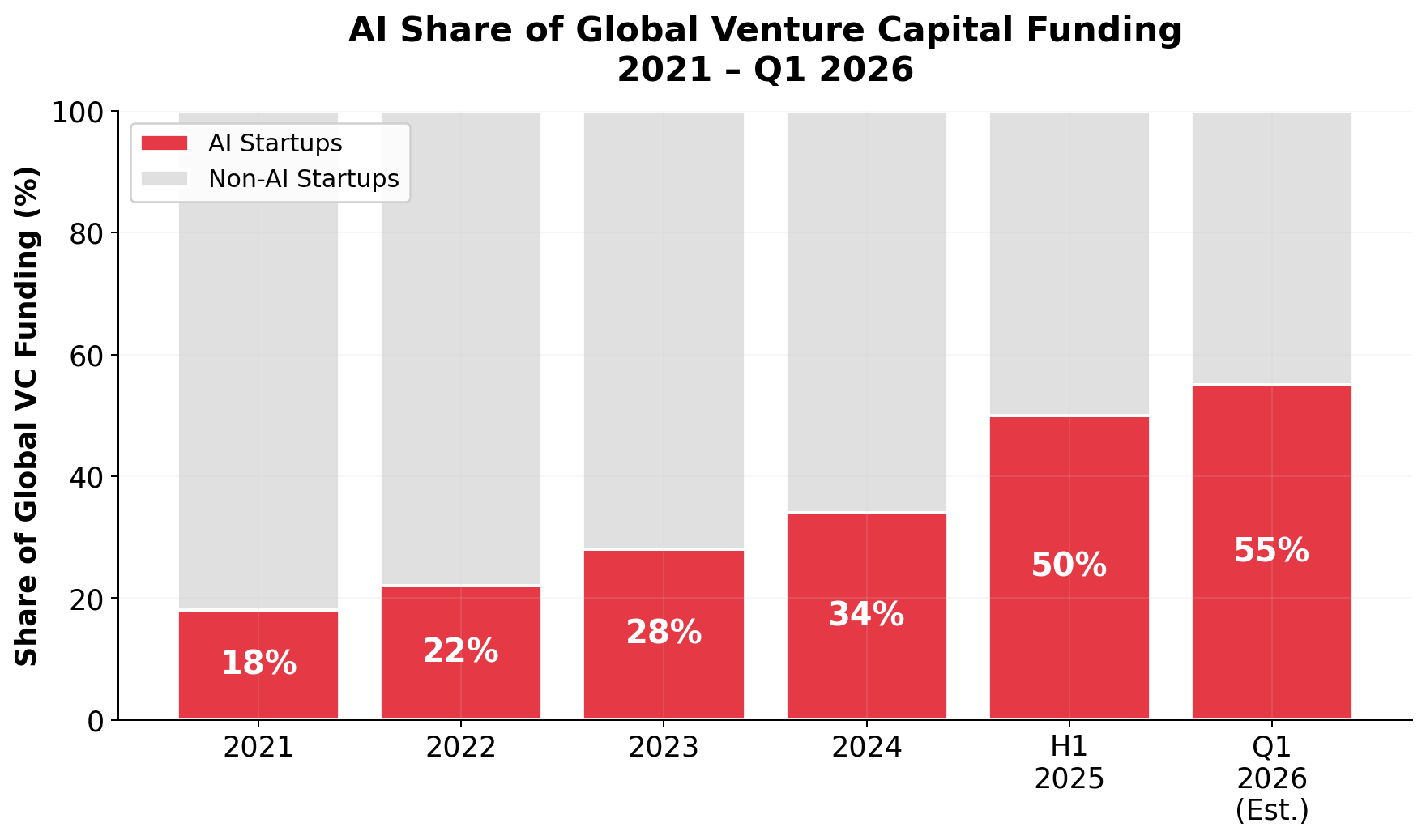
In 2025, approximately 50% of all global VC dollars went into AI startups, up from 34% in 2024 (Eqvista). CB Insights reported 266 AI M&A deals in Q1 2026 alone, a 90% increase year-over-year (FE International).
|
|
3. M&A Revenue Multiples
M&A revenue multiples measure the enterprise value at which a company is acquired — typically in a majority sale or full buyout. M&A multiples are typically lower than VC multiples but represent real “exit” values.
The Three-Tier M&A Landscape
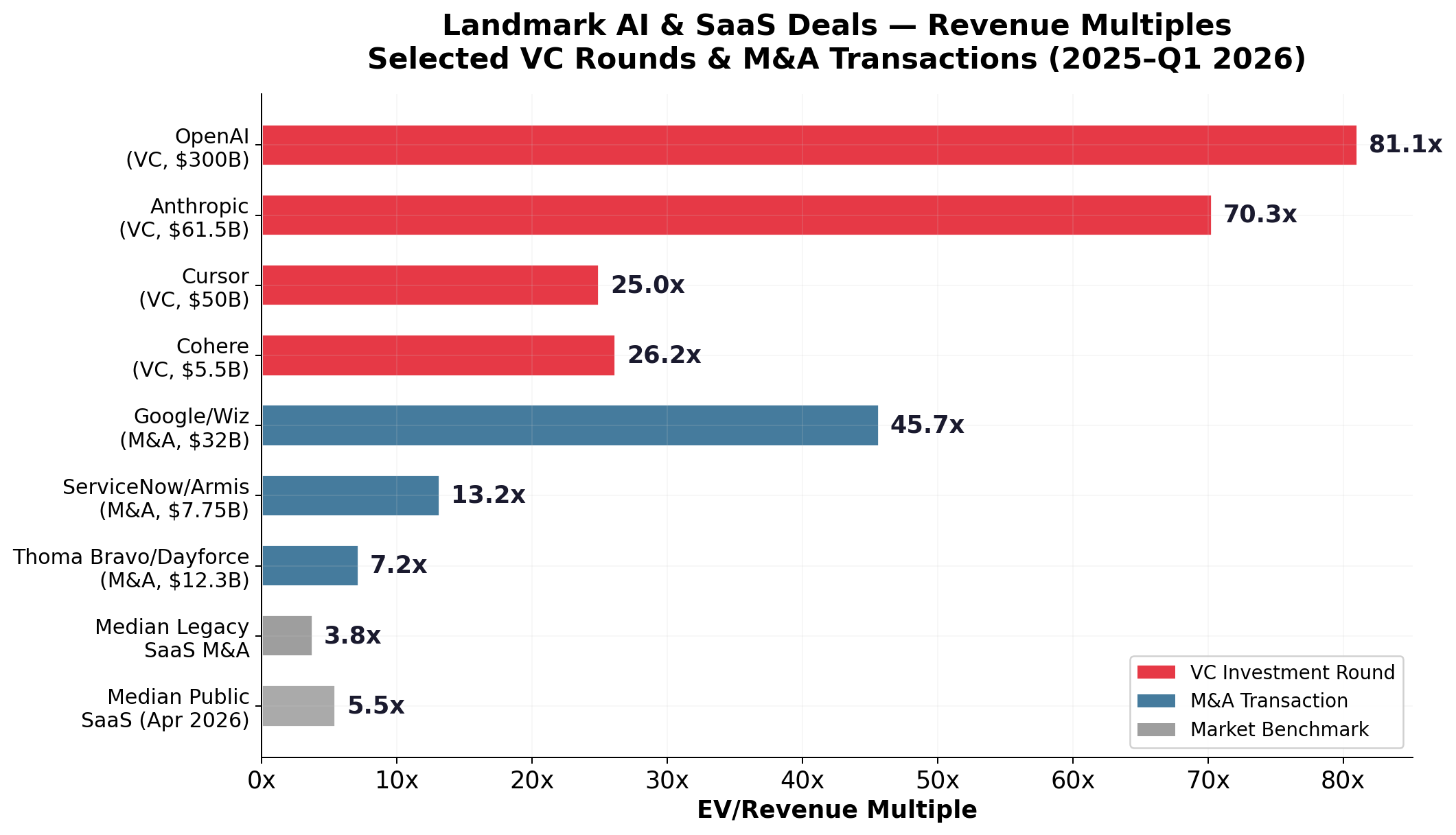
Q1 2026 saw an estimated 620+ SaaS-specific M&A transactions worth over $95 billion, headlined by Google’s $32B acquisition of Wiz, Palo Alto Networks’ $25B purchase of CyberArk, and Thoma Bravo’s $12.3B take-private of Dayforce (SaasRise Q1 2026).
|
|
|
FE International’s April 2026 analysis confirmed that AI-native companies command M&A revenue multiples of 8x to 15x, with outliers exceeding 20x for businesses with proprietary data assets and NRR above 120%.
M&A Multiples by Segment
| Segment |
Category |
M&A EV/Rev |
vs Avg |
| AI Infrastructure | AI-Native | 14.5x–15.0x | +175% |
| AI-Native SaaS | AI-Native | 9.5x–14.0x | +75% |
| Cybersecurity (AI) | AI-Enabled | ~11.0x | +107% |
| Healthcare IT (AI) | AI-Enabled | ~9.0x | +70% |
| Vertical SaaS | AI-Enabled | 7.0x–9.5x | +32-79% |
| Traditional SaaS | Legacy | 5.3x–5.4x | Baseline |
| Median Private SaaS | Legacy | 3.8x | Below |
Sources: Windsor Drake M&A Q1 2026; SaasRise Research.
|
Mega-Deal Case Studies
| Google/Wiz ($32B) — AI-powered cloud security at ~45.7x EV/Revenue. Largest pure-play SaaS acquisition in history. |
| |
| Palo Alto/CyberArk ($25B) — Identity security with AI at ~18-20x revenue. |
| |
| Meta/Scale AI ($14.3B) — AI data infrastructure at ~16.4x, reflecting strategic premium for AI training capabilities. |
| |
| Thoma Bravo/Dayforce ($12.3B) — AI-enhanced HR platform at ~7.2x. |
| |
| ServiceNow/Armis ($7.75B) — IoT/OT cybersecurity with AI at ~13.2x. |
| |
| ServiceNow/Moveworks ($3B) — AI-native workflow automation. Pure AI acquisition. |
|
|
|
Key Insight — M&A Multiples: AI-native companies sell for a median 11.5x revenue (top quartile reaching 14x+), vs just 3.8x for median private SaaS. Buyers pay more per dollar of revenue for AI-native capabilities because these companies grow faster, retain customers more effectively, and are more defensible long term.
|
|
4. VC vs M&A — Side-by-Side
One of the most important distinctions is between VC investment multiples (minority stakes, future potential pricing) and M&A revenue multiples (buyouts, control pricing). VC multiples run higher because investors price 5-7 year growth; M&A multiples run lower because acquirers assume operational risk and need to realize near-term value.
|
|
|
The data reveals a consistent pattern: the AI premium exists in both VC and M&A transactions, but is amplified in VC rounds. AI-native companies trade at approximately 1.8x their M&A value in VC rounds (21.2x vs 11.5x).
|
Sources: Composite analysis from all cited sources. Chart: SaasRise Research.
|
5. The SaaSpocalypse
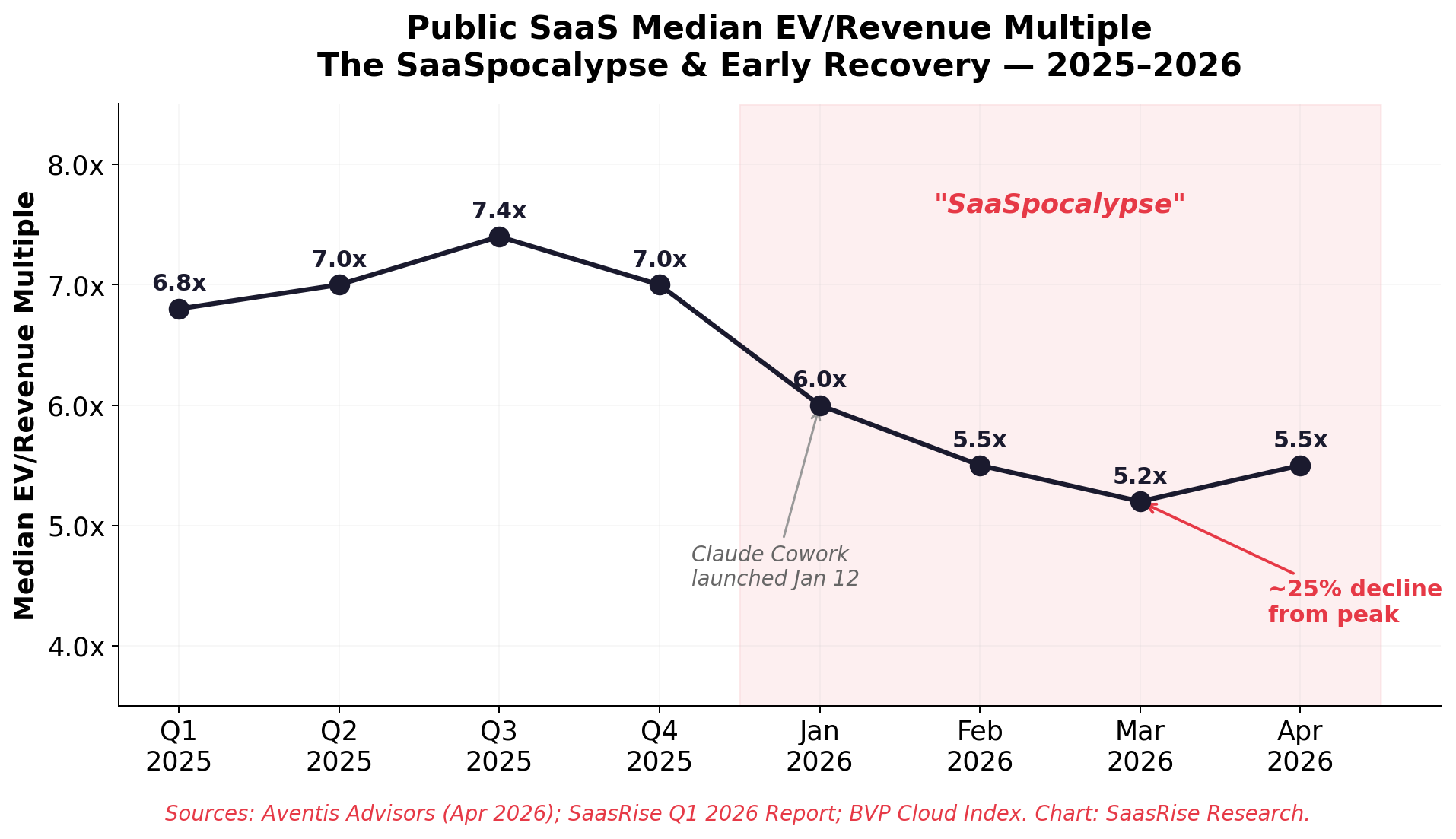
On January 12, 2026, Anthropic launched Claude Cowork — an autonomous AI agent capable of performing end-to-end business workflows (Taskade). Approximately $2 trillion in market cap was erased within weeks (Digital Applied). Public SaaS median EV/Revenue declined from ~7.0x to approximately 5.2x by March 2026 — a 25% compression from peak — before recovering to ~5.5x by April.
|
|
|
The structural driver: 40% of IT budgets are being reallocated from legacy SaaS toward agentic platforms and LLM token usage (MarketMinute). Per-seat pricing adoption dropped from 21% to 15% of enterprise contracts in 12 months.
|
6. Mid-Market Case Studies
For SaaS founders in the $1M to $100M ARR range, the data reveals stark patterns. AI-native companies in this range consistently command 30x-70x EV/Revenue, while AI-enabled trade at 7.5x-14x and legacy SaaS at 2.5x-7x.
Featured AI-Native Case Studies
|
Glean (Enterprise AI Search)
Series F · June 2025
$200M+ ARR · $7.2B valuation · ~36x EV/ARR
Raised $150M. Doubled ARR from $100M to $200M+ in 9 months. Powers knowledge discovery for enterprises globally.
|
|
Codeium/Windsurf (AI Coding)
Series C · February 2025
$40M ARR · $2.85B valuation · ~71x EV/ARR
Led by Kleiner Perkins. AI coding assistant competing with Cursor. Launched Windsurf Editor with agentic coding.
|
|
Runway ML (AI Video Generation)
Series E · February 2026
$70-80M ARR · $5.3B valuation · ~68-76x EV/ARR
Raised $315M. Creative AI platform with Gen-3 video models. Revenue growing ~140% YoY.
|
|
Lovable (AI App Builder)
Series B · December 2025
100K+ projects/day · $6.6B valuation · $330M raised
Led by CapitalG and Menlo Ventures. 25M+ total projects in first year. Strategic investors: NVIDIA, Salesforce, Databricks, Atlassian, HubSpot.
|
|
Jasper AI (Content Generation)
Series C · 2024
$180M proj. revenue · $1.8B est. valuation · ~10x EV/Revenue
AI content platform with 1.8M+ monthly users across 120+ countries. Shows multiples vary: Jasper at ~10x (wrapper) vs proprietary model companies at 30-70x+.
|
|
|
Key Pattern — Mid-Market AI-Native: Even at $40M-$330M ARR, AI-native companies command 30x-70x EV/Revenue. The premium is highest for proprietary models (Harvey ~100x, Codeium ~71x) and lower for API wrappers (Jasper ~10x). Authenticity matters.
|
|
Legacy SaaS Mid-Market: Compression Accelerating
For legacy SaaS in the $1M-$100M ARR range without meaningful AI, the multiple environment has deteriorated. Aventis Advisors reports median private SaaS M&A multiple fell to 3.1x as of March 2026 (from 3.8x in 2025), bottom quartile below 2.0x.
| ARR Range |
AI-Native |
AI-Enabled |
Legacy |
| $1M–$5M | 15x–30x | 6x–9x | 2.5x–4.0x |
| $5M–$20M | 20x–40x | 7x–12x | 3.0x–5.0x |
| $20M–$50M | 25x–50x | 8x–14x | 3.5x–6.0x |
| $50M–$100M | 30x–70x | 10x–16x | 4.0x–7.0x |
|
7. The Widening Gap
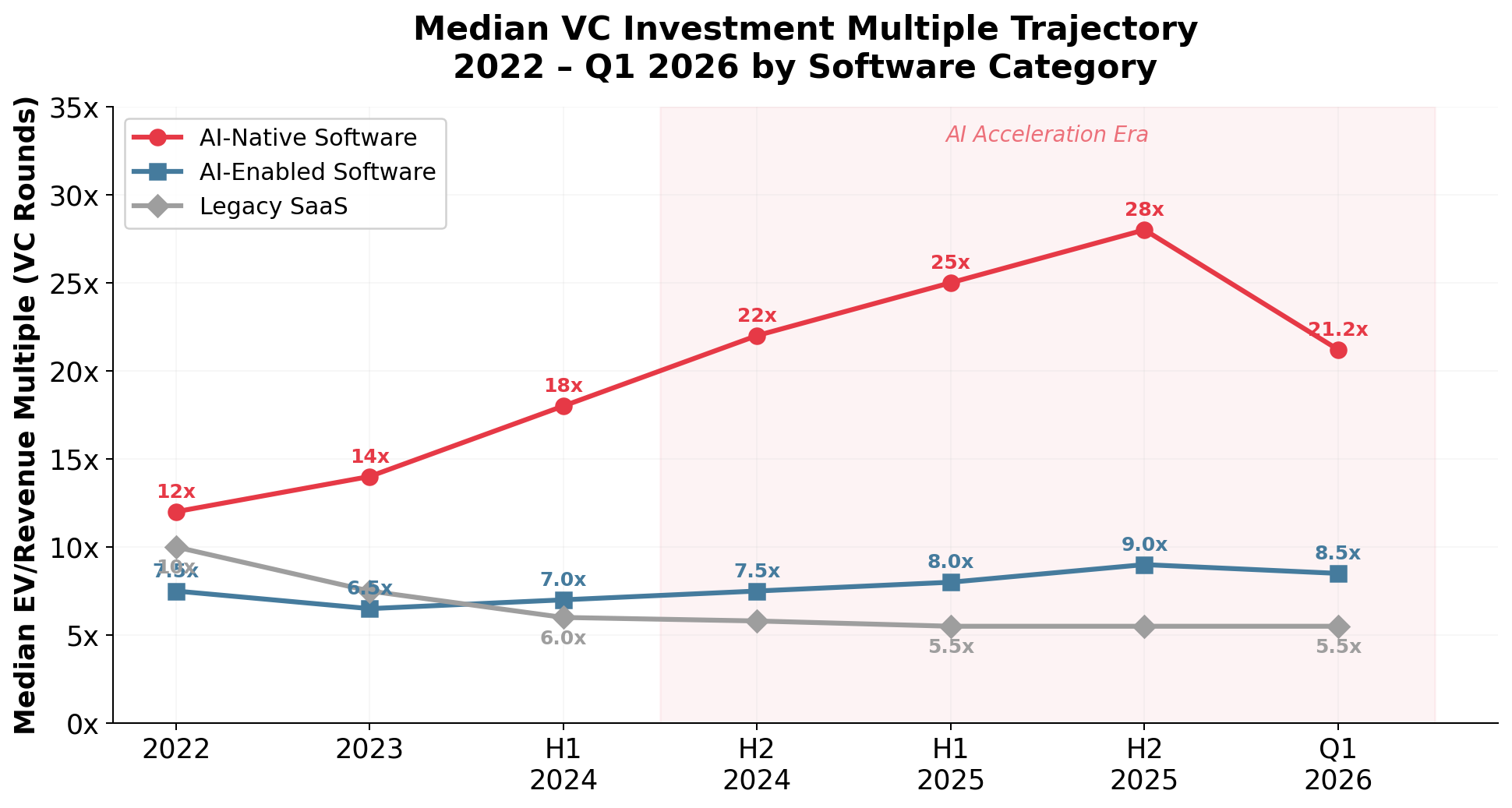
The AI valuation premium has accelerated dramatically since 2024. Tracing median VC investment multiples reveals a clear divergence between the three tiers.
|
|
|
1. AI-Native multiples surged in 2024-2025 as foundational AI companies demonstrated rapid revenue growth, pushing multiples from ~18x to ~28x.
2. Legacy SaaS multiples compressed as sector revenue growth slowed from 17% (Q4 2023) to 12.2% (Q4 2025).
3. AI-Enabled carved out a middle tier as investors rewarded meaningful AI integration but penalized superficial efforts.
4. Q1 2026 correction brought AI-native multiples down slightly from H2 2025 peak, but the gap vs legacy widened because legacy fell further.
The Efficiency Equation: Rule of 40 and AI
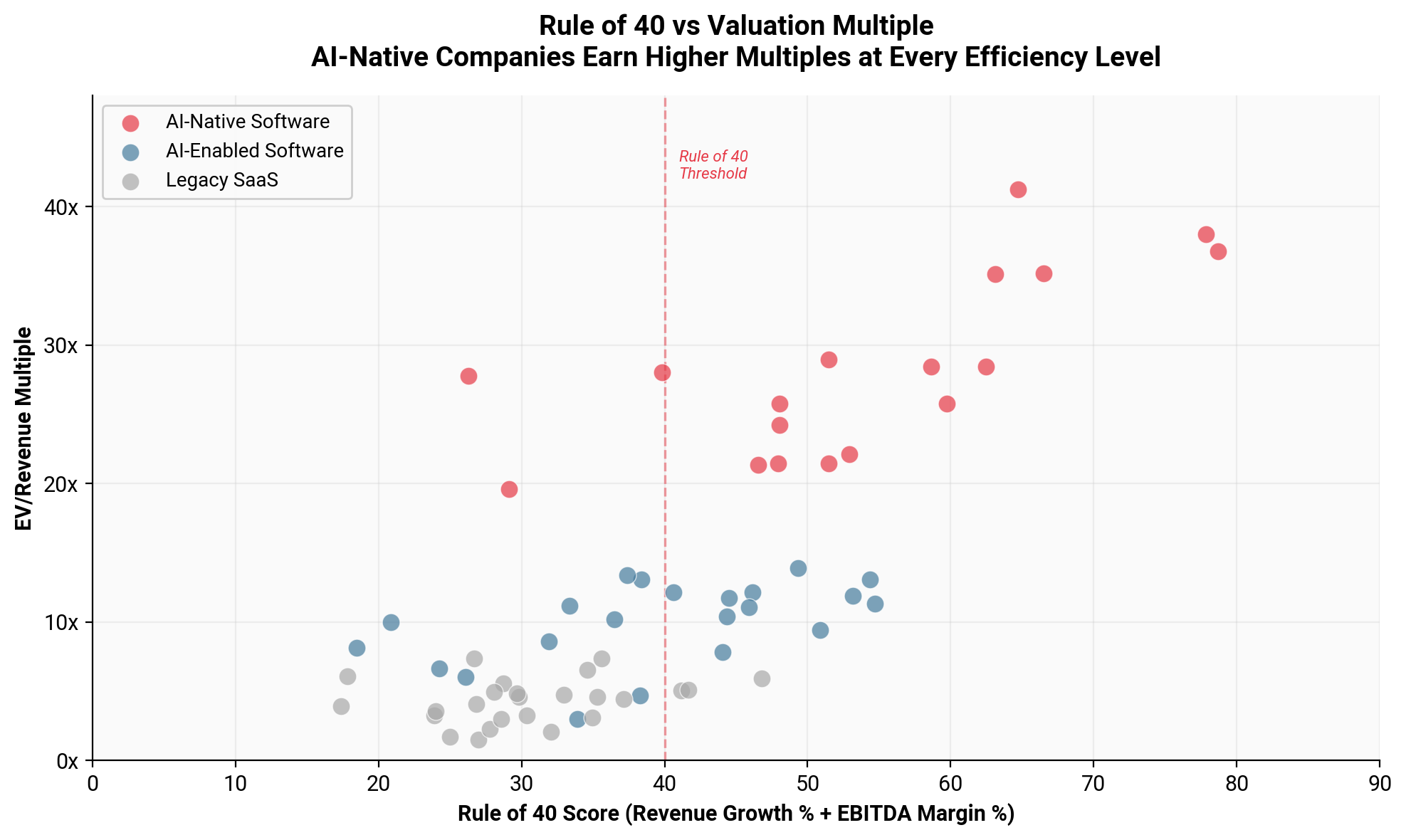
Aventis Advisors data shows each 10-point Rule of 40 improvement linked to a 1.1x increase in EV/Revenue. AI-native companies earn higher multiples at every Rule of 40 level compared to legacy SaaS — confirming the premium is structural.
|
|
8. AI Integration Framework
Windsor Drake’s Q1 2026 Report introduced a framework quantifying valuation premiums by depth of AI integration:
| Integration Level |
EV/Rev Range |
Premium |
| AI-Native Platform | 16.0x–18.0x | +40–80% |
| Deep AI Integration | 9.5x–14.0x | +40–60% |
| Moderate AI Features | 7.5x–9.5x | +20–35% |
| AI Roadmap Only | 6.0x–7.5x | +5–15% |
| No AI Strategy | 5.5x–7.0x | Baseline |
Windsor Drake emphasizes that “authenticity matters” — investors distinguish genuine AI value from “AI washing.” Proprietary AI commands higher premiums than third-party API wrappers.
|
9. The Coming AI IPO Wave
The ultimate test of AI-native valuation premiums will come with the expected IPOs of OpenAI, Anthropic, and Databricks in 2026 — carrying combined last-round valuations approaching $1.4 trillion (Morningstar/PitchBook). These public listings will set the benchmark for AI-native multiples and signal whether the premium is sustainable in liquid markets.
|
10. Conclusion: The Data is Unambiguous
The Bottom Line
→AI-native software commands significantly higher revenue multiples, and the premium is widening in 2026.
→Median VC Multiple: AI-Native 21.2x vs Legacy SaaS 5.5x (+285% premium)
→Median M&A Multiple: AI-Native 11.5x vs Legacy SaaS 3.8x (+203% premium)
→The market is not just rewarding AI — it is actively penalizing the absence of AI.
→The window for legacy SaaS to transition to “AI-enabled” is narrowing rapidly.
|
| Metric |
AI-Native |
AI-Enabled |
Legacy |
| VC Multiple | 21.2x | 8.5x | 5.5x |
| M&A Multiple | 11.5x | 7.0x | 3.8x |
| Public Multiple | 15x–35x | 8x–20x | 5.0x–5.5x |
| Revenue Growth | 50–100%+ | 15–40% | <12% |
| NRR | >135% | 105–130% | <105% |
For SaaS founders in the $1M to $100M ARR range, the implications are stark. A $40M ARR AI-native company (Codeium) commands a 71x multiple while a $100M+ ARR AI wrapper (Jasper) trades at just 10x. The difference is depth and authenticity of AI integration.
As Forrester stated: “Every company that survived a platform transition did so by abandoning the old pricing model before it was forced to.”
|
Join SaasRise — The #1 Mastermind for SaaS CEOs
Get weekly SaaS & AI valuation intel, connect with 500+ SaaS CEOs, and access exclusive deal data.
|
|
11. Sources & References
|
| |
|
© 2026 SaasRise Research. All data sourced from cited references.
saasrise.com ·
growthrise.com ·
venturerise.com
You’re receiving this because you subscribed to our newsletter.
Unsubscribe ·
View in browser
|